DE
DE EN
EN
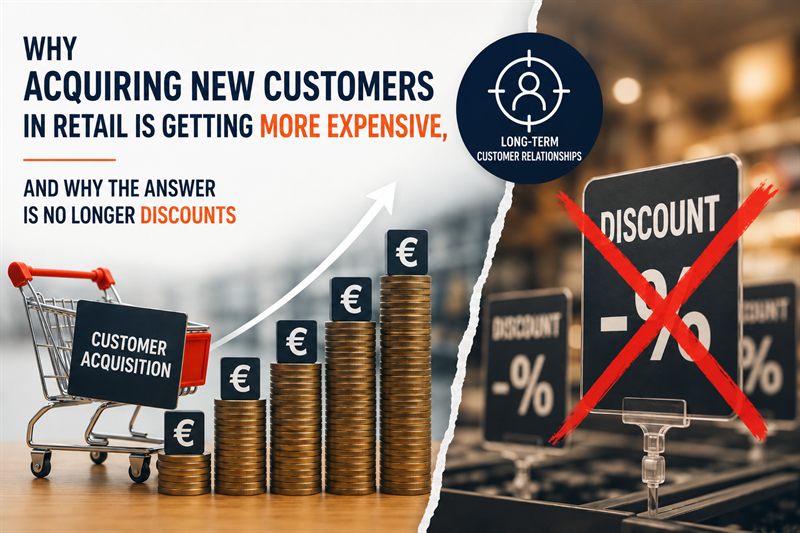
Discounts alone are no longer enough to bring customers back into physical retail. That's now widely understood. Less well known is that there is already academic research on a concrete counter-approach, not just opinions or individual providers' case studies.
What the real problem behind declining foot traffic is
Customers are less loyal to online offers than they used to be; that leads to lost revenue in physical retail and, in the worst case, to a decline in retail density in town centres.
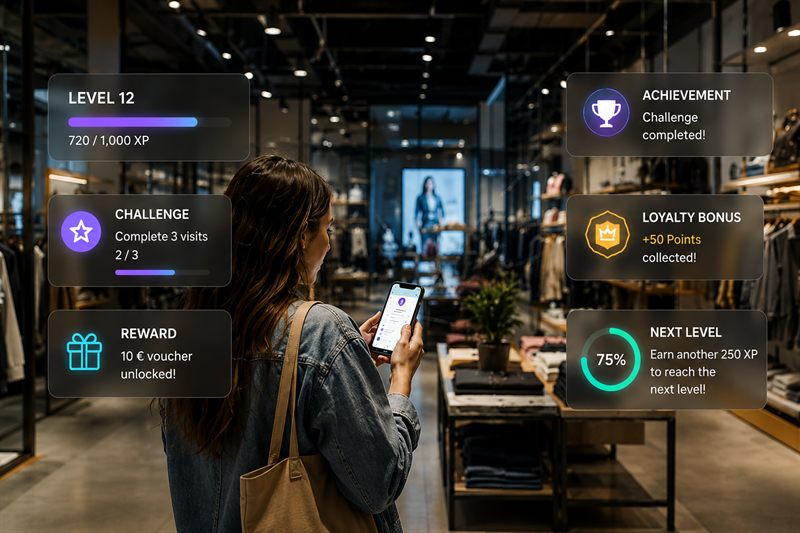
An obvious solution is to steer customers back into physical shops via mobile applications. The key question is how such an application has to be designed so that it is actually used, rather than sitting unused on the smartphone.
What an academic study shows about this
Exactly this approach was studied academically in 2017, in research by three researchers at TU Braunschweig, published under the title "Spielerisch lockt der Einzelhandel den Kunden, Einfluss von Belohnungen auf die Kanalwahl" ("Retail attracts the customer playfully: the influence of rewards on channel choice"). The study draws on the technology acceptance model, an established model from business psychology for explaining why people actually use a new application, or don't.
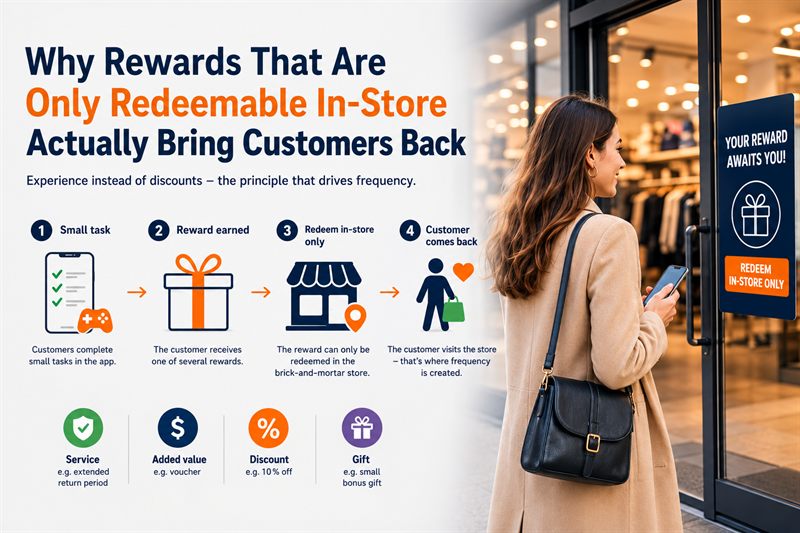
The mechanism: small task, reward, redemption only on site. The test was an app from a fictional retailer, in which users receive one of four possible rewards after completing small tasks. The rewards were a service such as an extended returns period, a monetary benefit such as a voucher, a discount, or an additional gift. Crucially, each of these rewards can only be redeemed in the physical shop, not online.
The specific result: the first online survey showed no clear preference for a particular reward type, though a slight trend towards the gift. In a subsequent lab experiment with a real app interface, gift and discount were clearly preferred over service and monetary benefit. More important than the detailed preference is the overarching finding: the basic idea of steering customers back into physical retail via playful rewards that can only be redeemed on site was, on the whole, accepted and rated positively by users, not rejected.
Why an industry representative argues in exactly this direction too
Alongside the academic study, there's an assessment that isn't itself a study, but confirms the same basic direction. As part of the "Frequenzbringer Handel" competition run by the IHK Niedersachsen (the Lower Saxony Chamber of Commerce), its retail spokesperson noted that foot traffic doesn't happen on its own, but when retail takes new paths and creates experiences that can't be replaced online.
That isn't an independent data collection, but a single opinion within the chamber's own marketing initiative. Yet it is still an indication that this view is shared outside academia too.
Source: IHK Niedersachsen (2025). Handel kann Frequenz, Wettbewerb Frequenzbringer Handel.
The real weight of this article lies with the academic study above. The IHK Niedersachsen assessment is merely an additional, supporting voice from practice, not evidence of equal standing.
Source: Stein, Eckardt, Robra-Bissantz (2017). Spielerisch lockt der Einzelhandel den Kunden, Einfluss von Belohnungen auf die Kanalwahl, HMD Praxis der Wirtschaftsinformatik, TU Braunschweig.
What that means for retail decision-makers
For retail decision-makers thinking about new loyalty measures, this yields a clear criterion. Not every app with a reward logic automatically generates foot traffic. What matters is whether the reward is tied to the physical place, or whether it could just as easily be redeemed online. Only in the first case does a structural, repeatable reason for the store visit arise, not a one-off purchase incentive.
Conclusion
The idea of bringing customers back into physical retail via playful rewards isn't just a trend; it can be backed by academic research. An industry representative from the IHK Niedersachsen points in the same direction. What matters is always the same mechanism: the reward must genuinely require the physical visit, not just accompany it.
Retail Gaming Solution is building a location-based platform that connects physical retail and brands in a digital ecosystem.