DE
DE EN
EN
More than bonus points and stamp cards
Walk through retail today and you'll meet gamification often, without recognising it as such. Digital stamp cards, bonus points, collection promotions or exclusive rewards for loyal customers have long been a fixed part of many customer programmes. Yet the term is regularly misunderstood. Some associate it with video games, others take gamification to be a dressed-up form of discount promotions. Both fall short.
The underlying idea is older than the word itself: people are motivated when they see progress, reach goals or are rewarded for particular activities. Fitness apps count steps and show weekly streaks. Language-learning apps reward daily practice sessions with points and badges. Streaming services keep users in the system through recommendations. In gaming, such motivation systems have been refined for decades. Retail is just discovering the underlying principles for itself.
What gamification concretely means
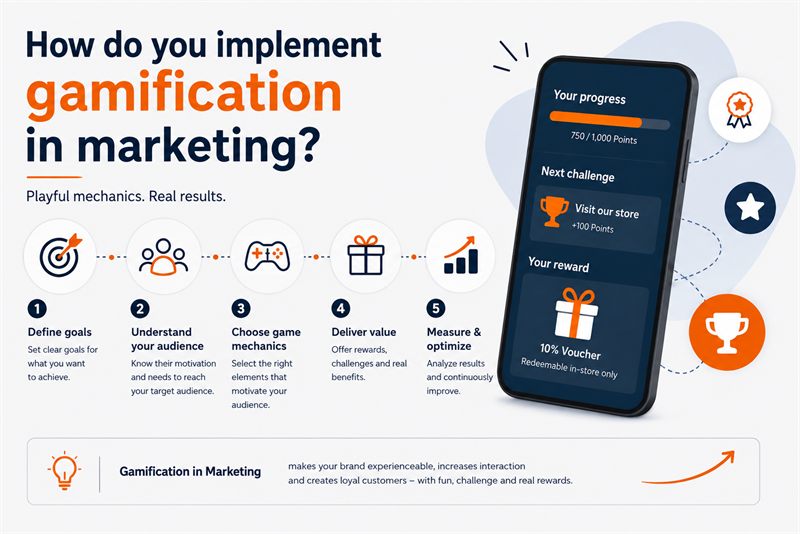
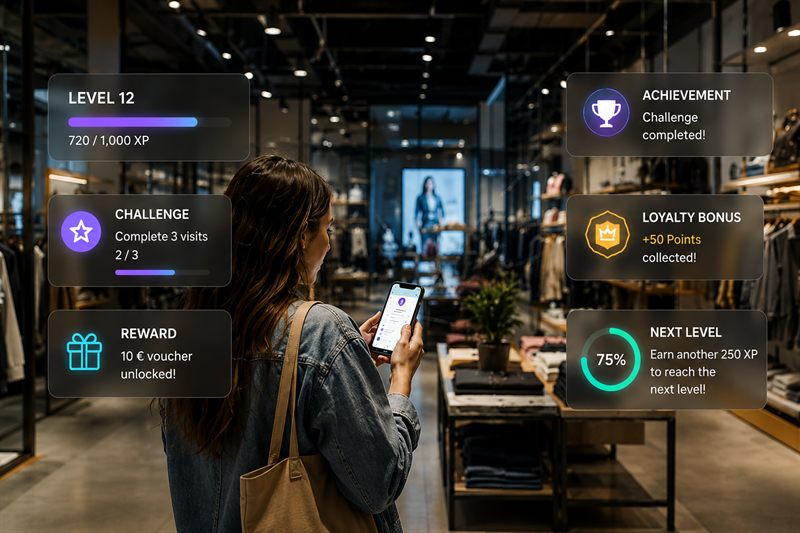
Gamification describes transferring game-typical mechanics to areas outside classic games. The goal isn't to turn a shop into a video game. It's to use elements that motivate people and give them a sense of progress, achievement or belonging. Points systems, collection promotions, challenges, digital badges and progress indicators are typical instruments. What matters isn't the individual element, but the psychological logic behind it: people want to reach goals, make achievements visible, and be part of a development.
These mechanics work because they connect to intrinsic motivation. They don't create a pure conditioning relationship like a discount; they create the feeling of achieving something. That difference matters more in retail than it seems at first glance.
Why gamification in retail is gaining importance
Retailers today no longer compete only with the shop across the street. They compete with every digital offer fighting for the same attention. Social media, streaming services, mobile games and online shops fight for the same minutes every day. In this environment, a pure purchase often isn't enough to stay in people's minds for long. The relationship with customers has to exist beyond the transaction if it's to be stable.
Gamification offers approaches for exactly that. It creates additional touchpoints between retailer and customer that aren't necessarily tied to a purchase. The interaction doesn't end at the till, but continues through digital channels. People remember experiences more strongly than advertising messages, and playful mechanics are designed to create experiences.
Where gamification is already used in retail today
Many retailers have long used playful mechanics without explicitly calling them gamification. Digital stamp cards are the most obvious example: after a certain number of purchases, there's a reward. The actual incentive doesn't only come from the reward itself, but from the visible progress on the way to it. Someone with seven of ten stamps comes back because the finish is within reach.
Points systems work similarly, with customers tracking their progress within a programme. Collection promotions are based on the same principle: the goal of completing a collection creates motivation that goes beyond the single purchase. Some companies also use time-limited challenges or special promotions to encourage additional interactions. What all these approaches have in common is the attempt to turn a one-off transaction into an ongoing relationship.
What gamification can and can't do
Used well, gamification can increase interactions, make digital offers more attractive and help customers come into contact with a brand more often. The emotional component is the decisive factor. Where classic advertising mostly creates short-term attention, playful motivation can foster a longer-term bond.
At the same time, gamification isn't a sure thing. Many projects fail because they merely introduce points or rewards without creating real value behind them. People don't engage with a system long term just because it hands out points. What matters is whether the underlying experience stays relevant and interesting. Without that core, even the most thought-out points system quickly loses its appeal.
On top of that, different audiences respond differently to playful mechanics. What works with one group need not land with another. Gamification supports products, services and customer experiences, but doesn't replace them. It's an amplifier, not a substitute.
Why classic gamification hits structural limits
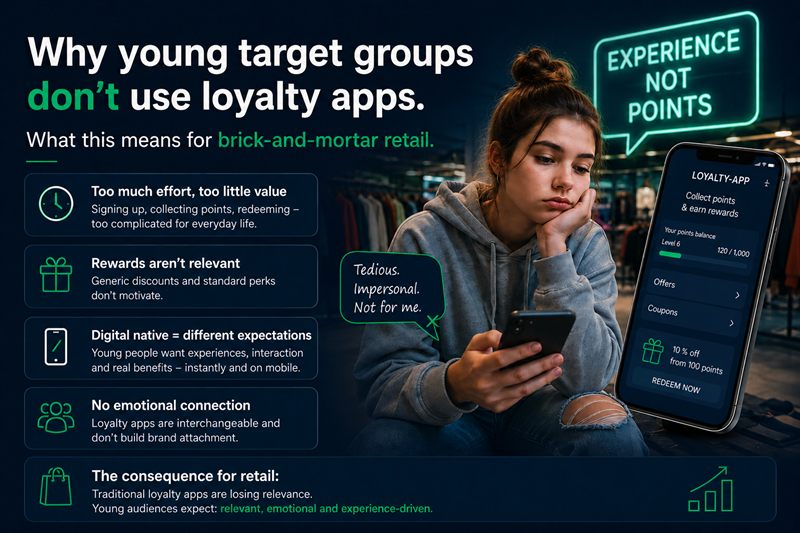
Many companies have recognised that playful mechanics can motivate customers, and integrate them into their existing apps or loyalty programmes. But this creates a hurdle that's often underestimated: the customer first has to download the app, create an account and return to the system regularly. Gamification that takes place inside a proprietary retailer app therefore assumes someone is already willing to enter that relationship.
That limits reach considerably. Anyone wanting to reach new audiences, that is, people with no active contact with the brand yet, hits the same limit with classic gamification as with classic loyalty programmes. The activation problem stays unsolved, because the approach comes in too late in the process.
The next step: when real places become part of digital worlds
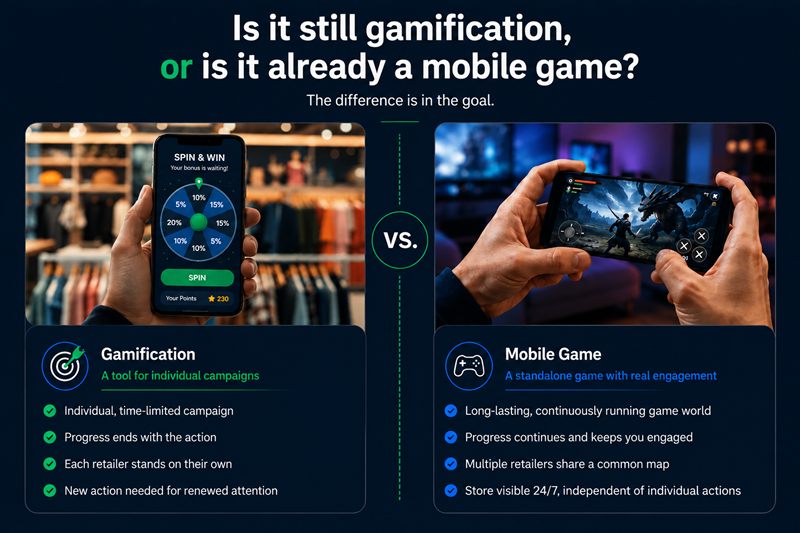
This is exactly where the discussion about Retail Gaming begins. Where gamification integrates individual playful mechanics into existing systems, Retail Gaming connects real places with digital experience worlds. The difference is structural: users don't have to come to yet another app. Instead, locations become part of a digital environment where attention already exists.
Retailers and brands thereby become anchor points in a world consumers visit every day anyway. Visiting a shop unlocks something that doesn't exist online, and so becomes a destination in itself. That's a different starting point from the one classic gamification takes, and it addresses the customer-activation problem where it actually arises.
Conclusion
Gamification in retail is far more than a modern buzzword. It describes the attempt to deliberately use insights about motivation, progress and interaction to make customer experiences more attractive and build relationships that reach beyond the single transaction. For retailers, it offers real ways to foster loyalty and interaction, as long as there's genuine value behind the playful elements.
Where classic gamification reaches its limits, namely on the question of how to reach people who have no relationship with the brand yet, Retail Gaming comes in. The question is no longer whether playful mechanics will play a role in retail. They already do. The more relevant question is how far this approach is thought through, and whether retailers are willing to see their locations as part of a digital world where their target audience is already at home.
Retail Gaming Solution is building a location-based platform that connects physical retail and brands in a digital ecosystem.