DE
DE EN
EN
A cost problem many retailers tackle the wrong way
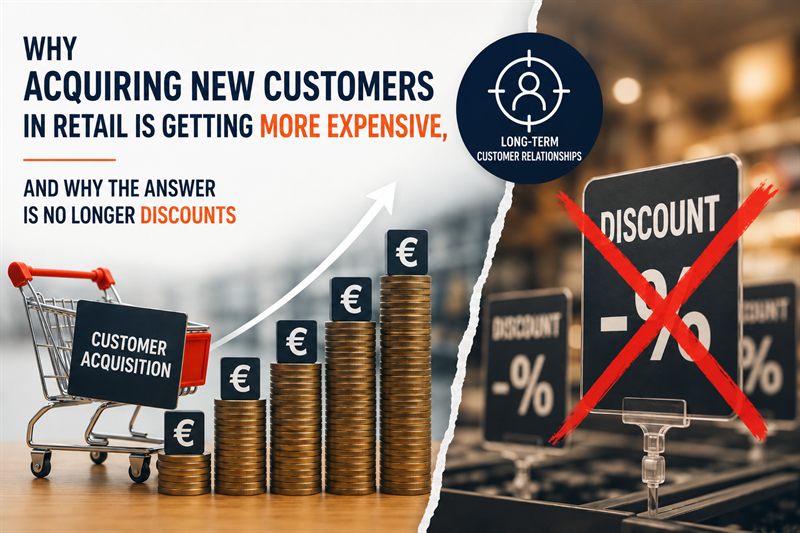
A rule of thumb common in the marketing industry holds that winning a new customer can be up to seven times more expensive than retaining an existing one. In retail, this rule is no exception; if anything, the effect is amplified, as classic advertising channels such as print, local ads or unaddressed leaflets lose impact while digital ad space gets more expensive at the same time.
Many retailers respond with the one lever that's easy to pull in the short term: price. Discount promotions, introductory offers, first-buyer vouchers.
The problem with this response isn't that it's ineffective. A discount almost always creates a short-term buying impulse. The problem is what happens afterwards.
Source: HORIZONT (2021). Neukunden-Akquise oder Bestandskunden-Pflege.
Why discounts tend to worsen the real problem rather than solve it
A discount customer comes for one reason: the price advantage. As soon as that advantage ends, in many cases so does the relationship with the retailer. No bond forms with the brand, the store or the shopping experience, only a bond with the cheapest price available at that moment. When a competitor runs the next promotion, the same customer moves on.
Discount customers are rarely loyal customers. You can also see this in the fact that many retail companies have to keep repeating or even intensifying their discount promotions to achieve the same effect, a pattern that points to declining effectiveness, not a successful strategy.
That creates an expensive loop. Rising acquisition costs are met with more discounting. More discounting attracts customers who are especially price-sensitive and especially unlikely to return. So new customers have to be won again, again through discounting, again at the same cost.
Where the rising costs actually come from
A major reason for rising acquisition costs is where potential customers' attention actually is today. Younger audiences in particular spend a significant part of their day in digital environments: social networks, streaming services and mobile applications. Classic retail advertising barely reaches these environments, and the digital channels these audiences actually use are increasingly expensive and ineffective for one-off discount advertising, as ad density there is already high.
That means the real problem isn't purely a price problem, but a visibility problem. A retailer can't advertise more cheaply if the target audience no longer uses the advertising channel regularly at all.
Source: Mittelstand-Digital Zentrum Handel (2026). Warum sich der Blick auf die Generation Z lohnt.
What sets emotional loyalty apart from a discount
Emotional customer loyalty doesn't come from a one-off price advantage, but from a recurring, positive experience associated with a store or a brand. The decisive difference lies in what a customer associates with the visit. A discount links the visit to a low price. A positive experience links the visit to a memory that goes beyond the purchase itself.
This difference directly affects the return rate. A customer who comes back because of an experience is less dependent on competitors' current discount promotions than a customer who originally came only for the price.
What that means for retail decision-makers
For marketing leads and store managers in retail, this shifts the question that actually matters. Not how big the next discount has to be to attract enough new customers, but how a store becomes visible again in potential new customers' digital everyday life at all, regardless of price.
Anyone who continues to win new customers solely through discounting will keep facing rising acquisition costs, because the underlying cause, a lack of visibility in the target audience's digital everyday life, doesn't change as a result. Anyone who instead starts to create real experiences and recurring touchpoints addresses the cause, not just the symptom.
Conclusion
New customer acquisition in retail isn't getting more expensive primarily because there's too little discounting. It's getting more expensive because classic advertising channels reach the target audience less and less often, while discounts at the same time attract exactly the customers least likely to return. The more sustainable answer isn't a bigger discount, but real, recurring visibility in the target audience's everyday life.
Retail Gaming Solution is building a location-based platform that connects physical retail and brands in a digital ecosystem.