DE
DE EN
EN
If you look into gamification in retail, you quickly come across a whole range of providers that build prize wheels, scratch cards or digital advent calendars for marketing campaigns. That is gamification, and it works well enough for its purpose. But it is something fundamentally different from what we're building at Retail Gaming Solution: a real mobile game. That difference is worth spelling out clearly.
What a gamification tool actually is
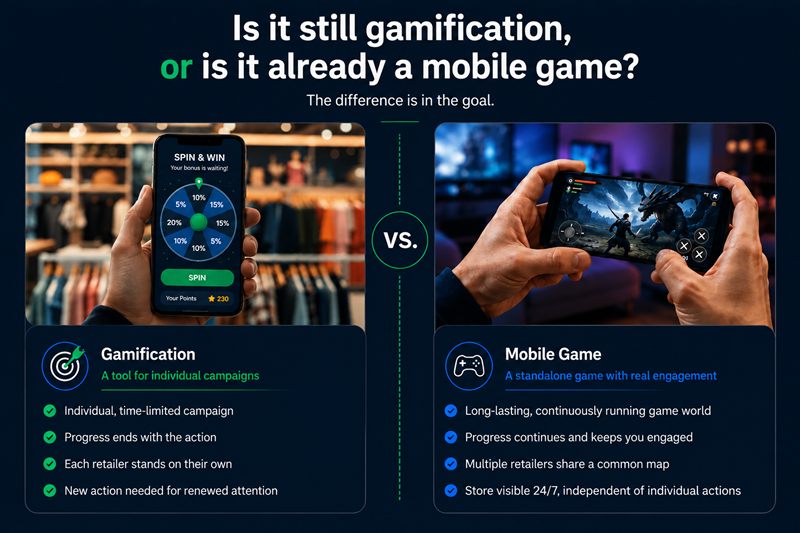
A classic gamification tool is a kit for individual, time-limited campaigns. A retailer uses it to create, say, a prize wheel for two weeks, tied to an existing newsletter or an ad campaign. The campaign runs, generates short-term attention, and then ends. For the next promotion, a new campaign is set up. Each campaign stands on its own; there is no ongoing connection between them.
That isn't a criticism of these tools – they are built for exactly this purpose: short-term, campaign-driven activation, usually alongside advertising that was planned anyway.
What sets a mobile game apart
A mobile game isn't a single campaign, but an ongoing world that persists. At Retail Gaming Solution, real locations become a permanent part of a digital game world – not for two weeks, but continuously. A player doesn't come back because of a single promotion, but because their progress, the items they've collected and their status in that world persist over time.
The difference comes down to a simple question. With a gamification tool, the campaign ends and everything the user achieved is meaningless afterwards. With a mobile game, the progress made stays in place and becomes the basis for what comes next.
Why that makes a practical difference for retailers
A single campaign creates a short burst of attention; after that it goes quiet again until the next promotion is set up. A permanent mobile game, by contrast, creates a continuous incentive to return, whether or not the retailer is currently running an active campaign. The store is always part of the game world, not just during a promotion, and therefore visible inside the game around the clock, not only for the length of a single campaign.
It also changes the position of the individual retailer within the system. In a gamification tool, every retailer stands alone; their campaign competes, at most indirectly, with other advertising for attention. In a shared mobile game, several retailers are part of the same map, the same community of players, who give each other reach without a new campaign being needed.
Why this distinction is still rarely made
In German-speaking markets, the term gamification is mostly used as a catch-all for anything that builds playful elements into marketing, regardless of whether it's a single promotion or an ongoing mobile game. As a result, campaign tools and actual games fall into the same category, even though they solve different problems. For a retailer looking for a short-term promotion, a gamification tool is the right choice. For a retailer who wants to build lasting foot traffic and repeat visits, a mobile game is the more fitting category.
What searching for this topic reveals
Before writing this article, we checked for ourselves how often people actually search for terms like "gamification alternative", "location-based marketing" or similar phrasings. Across several rounds of research and around 50 tested terms – from classic marketing language through retail jargon to genuine gaming vocabulary – we found barely any measurable search volume with matching intent.
At first glance that was sobering. On closer inspection, though, it's more of a confirmation of what this article describes. People can't search specifically for something that doesn't yet have an established word. The category of a real mobile game rather than a gamification tool barely exists in German-speaking markets so far, so no search vocabulary has developed for it either. That's one of the reasons we explain this difference at length here: not because people are already searching for it, but because no one has yet named it this clearly.
Conclusion
Gamification tools and a real mobile game solve different problems. One creates short-term attention through individual campaigns; the other builds a lasting game world in which real places play an ongoing role. Both have their place, but before deciding, it's worth knowing which of the two problems you actually want to solve.
Retail Gaming Solution is building a location-based platform that connects physical retail and brands in a digital ecosystem.