DE
DE EN
EN
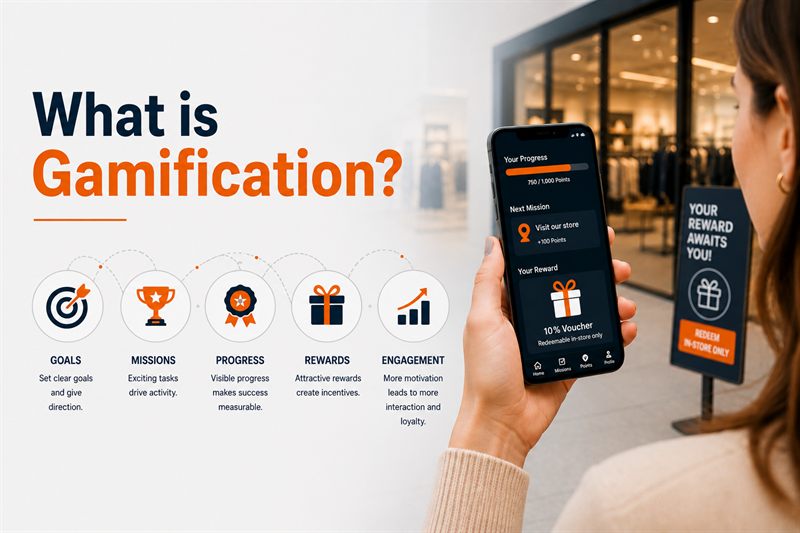
Gamification means using game-typical elements and mechanics in areas that aren't games in themselves. Rather than developing a standalone game, individual building blocks from game design, such as points, progress, rewards or competition, are transferred into contexts like marketing, education, the workplace or retail, in order to influence motivation and behaviour in a targeted way. In German, the terms "Gamifizierung" or "Spielifizierung" are sometimes used as synonyms; they mean the same concept.
How does gamification differ from a game?
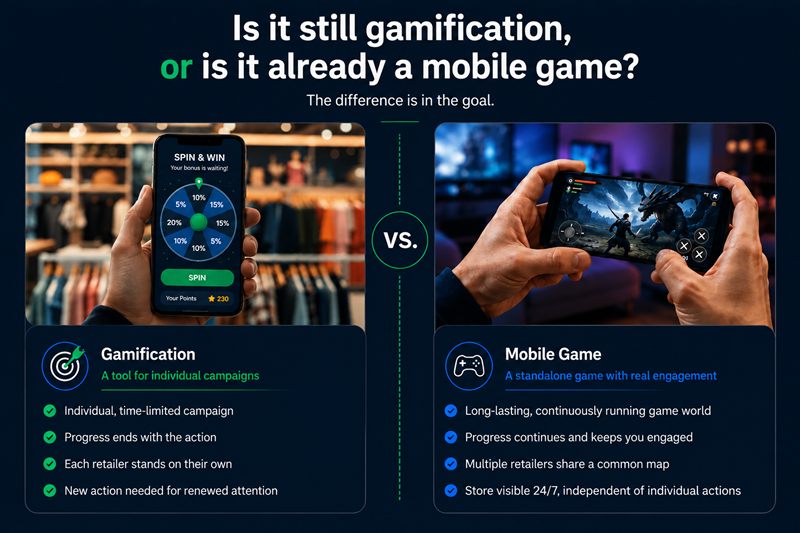
A central misunderstanding is to equate gamification with a full game. A game usually has entertainment as an end in itself. Gamification, by contrast, uses only selected game elements to support an existing, non-game goal, such as more exercise in daily life, better learning outcomes, or more visits to a shop.
The US gamification researcher Karl Kapp described this distinction systematically early on, in his widely cited work on the gamification of learning and training (cf. Kapp, 2012).
What are examples of gamification?
Gamification is found today in very different fields. Fitness apps use progress bars and badges to encourage regular exercise. E-learning platforms use points and leaderboards to make learning progress visible. Gamification has also been established in HR for years. In people development, internal training programmes often add progress levels and certification badges to make learning paths visible and motivating.
In recruitment, larger companies increasingly use playful assessment elements to get to know applicants in a different way from classic tests. Sales teams also use gamification, for example when internal targets are shown as leaderboards or progress indicators to motivate teams.
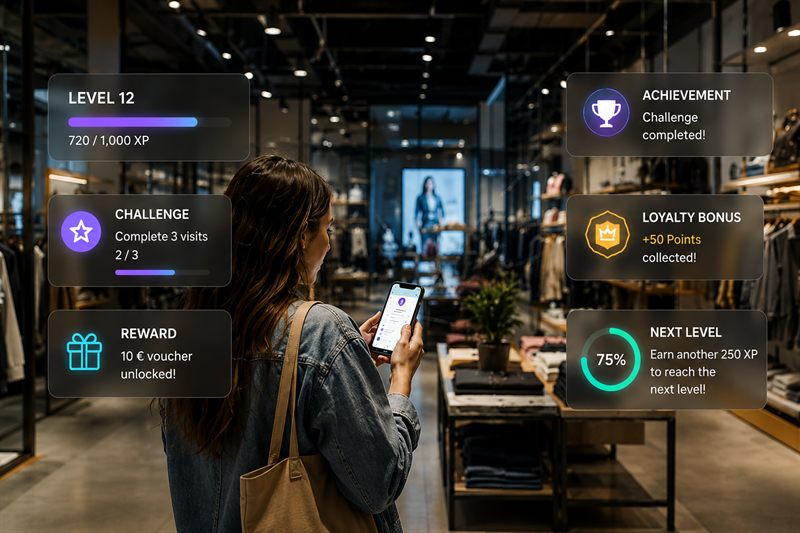
In physical retail, gamification is still a young field of practice. This is where our platform comes in, embedding physical locations into a mobile game so that players are motivated by the game to visit a real store and shop there. As Retail Gaming Solution is currently in its pilot phase, our own reliable data on this will only be available once the first pilot projects are complete.
What are the advantages and disadvantages of gamification?
Gamification can noticeably increase motivation and engagement in the short term, because it provides immediate feedback and visible progress. It is particularly suited to situations where a task is meant to be carried out repeatedly and over a longer period.
At the same time, gamification has recognised limits. A frequently described problem is the novelty effect, where motivation fades after the initial enthusiasm if no new incentives are added. Another risk is the so-called crowding-out effect, where an originally intrinsic motivation can be weakened by external rewards.
Gamification also doesn't work equally well with every audience, as people respond differently to competition, reward or social recognition. Reputable providers should name these limits openly, rather than presenting gamification as a universal solution.
Which elements and models shape gamification?
In practice, a basic combination of points, badges and leaderboards is often used, frequently abbreviated in English as PBL. Progress indicators, story elements and feedback loops are added on top. A well-known, more comprehensive model for categorising gamification elements comes from Yu-kai Chou, who systematically assigns various human drivers such as progress, ownership or social belonging to a gamification framework (cf. Chou, 2015). Anyone wanting to go deeper into the game-theory foundations will also find more detailed categorisations of formal game elements such as rules, goals and challenges in the classic game-design literature.
Conclusion
Gamification deliberately transfers individual game elements such as points, progress or rewards into non-game areas, in order to influence motivation and behaviour positively, without itself becoming a standalone game. The concept has long been established across industries, from people development through recruitment to sales, and it works best where a task is meant to be carried out repeatedly over a longer period.
At the same time, gamification is no substitute for a well thought-out strategy; its effect depends heavily on how precisely the elements used are tailored to the particular audience and their motivation. In physical retail too, this potential is still largely untapped, and that's exactly where the Retail Gaming Solution approach comes in.
Sources
Kapp, K. M. (2012). The Gamification of Learning and Instruction. Pfeiffer.
Chou, Y. (2015). Actionable Gamification. Beyond Points, Badges, and Leaderboards. Octalysis Media.
Retail Gaming Solution is building a location-based platform that connects physical retail and brands in a digital ecosystem.