DE
DE EN
EN
The wrong question costs millions
Many companies in retail ask themselves the same question: why don't customers download our app? They invest in development, design and marketing budget, optimise onboarding flows and test new features. The result still often falls short of expectations. The reason isn't that the app is bad. The reason is that the question is framed wrongly.
The right question is: why should anyone download this app at all? And, even more concretely, if you take the target audience seriously: why should a gamer who spends every day in digital worlds install a retailer's loyalty app? Anyone who answers this question honestly understands why so many customer loyalty programmes structurally miss their audience.
What loyalty programmes can and can't do
Loyalty programmes work. That's not in question. Many companies demonstrably achieve good results with loyalty cards, bonus points and cashback models. They strengthen existing customer relationships, encourage repeat purchases and create a direct communication channel to existing customers. That's valuable and will stay valuable.
The real problem lies elsewhere: loyalty programmes are aimed at people who are already customers. They improve customer retention. What they structurally don't do is customer activation. And that's exactly the challenge many retailers face today. Not the question of how to bring existing customers back more often, but how to reach people who have no active relationship with the brand yet.
Customer retention and customer activation are two different tasks
In retail, these two terms are often lumped together, even though they pursue fundamentally different goals. Customer retention asks: how do we get existing customers to come back more often? The instruments for that are familiar: bonus programmes, coupons, discounts, digital loyalty cards, cashback systems. They work because they build on a relationship that already exists.
Customer activation asks a different question: how do we motivate people who have no active relationship with our brand yet? This is about new audiences, additional visits, new purchase occasions and greater attention in a market environment that gets louder every day. It's precisely on customer activation that classic loyalty programmes reach their limits, because they assume someone is already willing to enter a relationship before the actual motivation for it has arisen.
Why the download itself is already the problem
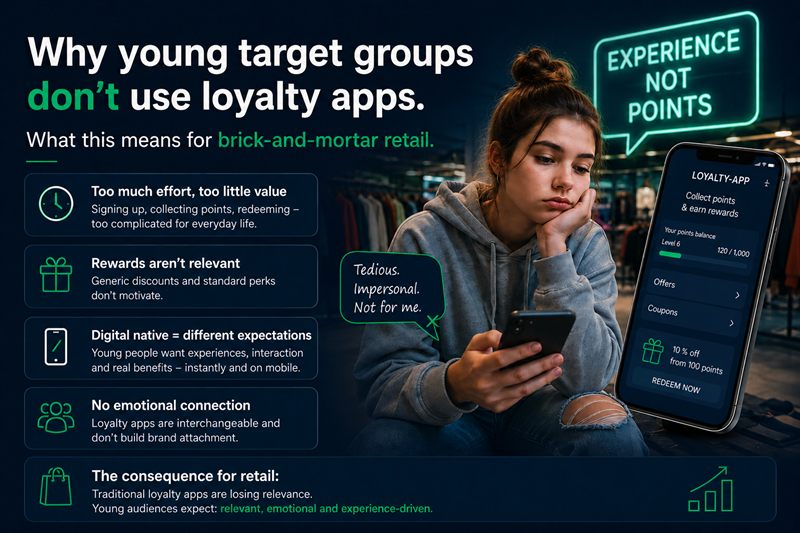
For companies, an app download often looks like a small intermediate step on the way to customer loyalty. For users, it's often the biggest hurdle in the whole process. Before an app is used permanently, it has to be discovered, understood, installed and linked to an account. Privacy settings have to be accepted, notifications want configuring, and then the app has to be opened regularly without any external prompt forcing it. Every single one of these steps reduces the likelihood of long-term use.
But the real problem runs deeper. A retailer's loyalty app doesn't just compete with other retailer apps. It competes with every digital offer fighting for the same user's attention: mobile games, TikTok, Instagram, YouTube, Twitch, streaming services, messengers and social networks. In this competition for attention, every offer needs a clearly recognisable added value that justifies the download. For many retailer apps, that added value simply doesn't exist from the users' point of view.
What gaming teaches about motivation
Gaming is now one of the biggest entertainment industries worldwide, and the success of modern games isn't based on entertainment alone. It's based on motivation. Players come back every day because they want to make progress, complete collections, unlock new content, solve challenges and be part of a community. This motivation doesn't come from discounts. It comes from goals, from experiencing progress, and from experiences that are worthwhile.
Younger generations grow up with these mechanics. Level systems, achievements, quests, collectibles, virtual rewards, leaderboards and time-limited events aren't special features; they're the normal course of a digital everyday life. Anyone wanting to understand why classic loyalty approaches structurally miss this audience has to understand what this audience interacts with every day and what it's used to expecting.
Why classic gamification in retail often falls short
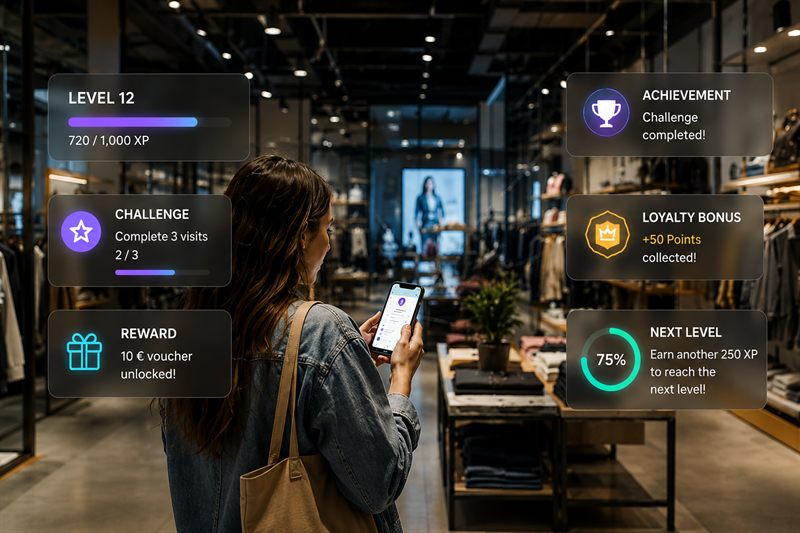
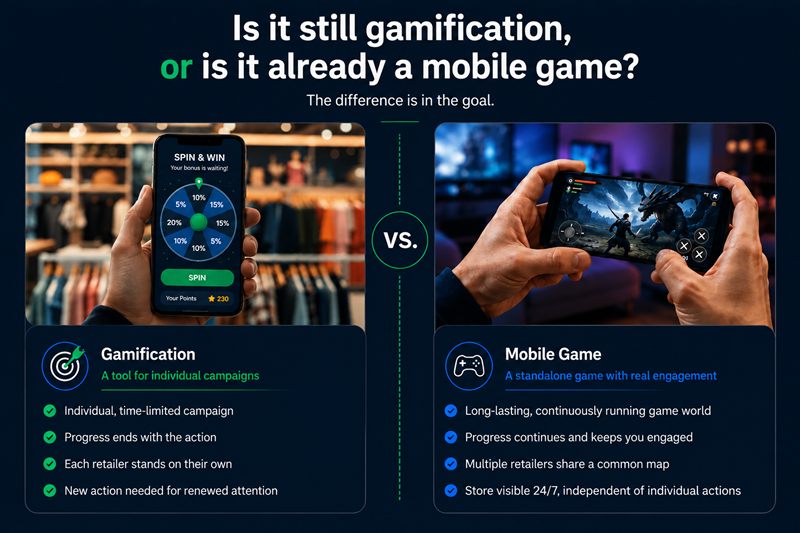
Many retailers have already responded and integrated gamification elements into their apps. Digital stamp cards, collection points, badges, prize draws and challenges are now widespread. These approaches can have positive effects, but have a structural problem: they take place inside the existing retailer app. So the user first has to download it and use it regularly. That reproduces exactly the same hurdle it's supposed to overcome.
As long as gamification exists as a feature inside a proprietary app, it stays limited to existing customers. It improves retention, but doesn't solve the activation problem. Anyone wanting to reach new audiences has to be present where their attention already is, and not hope they're willing to install a new app for it.
A different model: not one brand's app, but a world brands are invited into
Behind every loyalty programme is the same basic principle: every brand builds its own digital world. Every brand develops its own app, its own points system, its own communication structure. For users, that means more downloads, more accounts, more notifications and more complexity, without the perceived value rising proportionally.
Retail Gaming follows a structurally different idea. Instead of every brand trying to draw users into its own digital world, real shops become part of a digital environment where attention already exists. Real places become visible where users already are. Customers don't have to keep discovering new platforms. Instead, the locations come to where the target audience is already active every day.
What that means for physical retail
Physical retail faces a task that can't be solved with another bonus programme. People spend a significant part of their day in digital environments, and the question is no longer how to get them to download yet another app. The question is how real locations can become part of their target audience's digital reality.
That requires a shift in perspective. Not: how do we bring people into our app? But: how do we create experiences that connect digital motivation with real visits? Anyone who wants to grow doesn't just need existing customers. They need new visitors, new audiences and new purchase occasions. Customer activation will therefore become more important than customer retention for many companies in future, even though both have their place.
Conclusion
Loyalty programmes will remain a fixed part of many retail strategies. They're effective when it comes to strengthening existing relationships and encouraging repeat purchases. But the challenge physical retail faces today increasingly lies elsewhere: younger audiences spend their attention in digital worlds that classic retailer apps structurally don't reach.
The answer to that isn't a better points system or a dressed-up app. The answer lies in the question of how real places can become part of a digital experience that people seek out of their own accord. Retail Gaming describes this approach: not through more advertising, not through more coupons, but through experiences that connect digital motivation with real visits so that visiting a shop becomes a destination in itself.
Retail Gaming Solution is building a location-based platform that connects physical retail and brands in a digital ecosystem.