DE
DE EN
EN
Why a purchase decision in a game takes only seconds
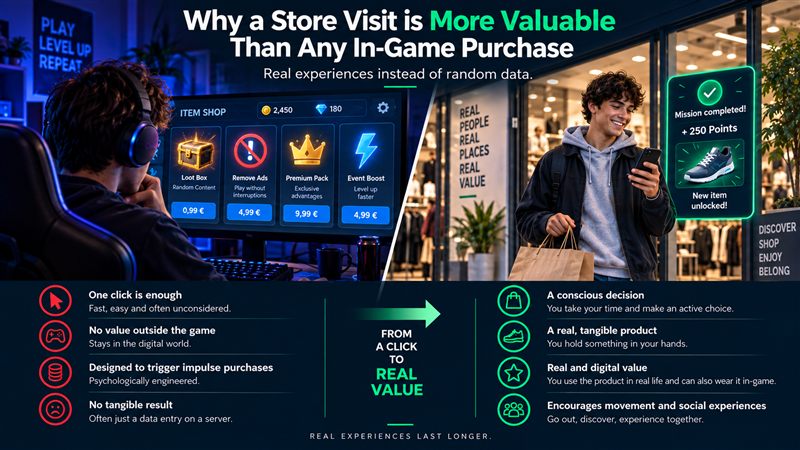
In most video games, a purchase decision takes only a few seconds. One click is enough, and one, two, five, ten, twenty, fifty or even a hundred euros change hands, whether for a single item, a premium pack, ad-free play, an advantage in a time-limited event, or a randomly assembled virtual loot box. Anyone who plays mobile games regularly knows these purchase prompts all too well, some version of them shows up in almost every title. This speed is no accident, it is the actual business model. Loot boxes are by far the best researched of these mechanics, which is why the rest of this article focuses mainly on them, but the underlying mechanic carries over to most of these purchase incentives. A recent study from 2024, published in the journal Entertainment Computing, examined the fundamental mechanisms behind it. More than three hundred players were surveyed about their purchasing behaviour around so-called microtransactions. The result: a sense of reward, a positive gaming experience and social pressure within a community deliberately drive impulse purchases. The purchase decision is designed to require as little thought as possible.
Loot boxes are facing growing political pressure
This mechanic is now increasingly being challenged politically too. In the summer of 2025, the European Commission published guidelines pushing for stricter standards to protect minors from gambling-like elements in video games. Shortly afterwards, the state governments of Mecklenburg-Western Pomerania, Saarland and Bremen submitted a resolution to the Bundesrat, Germany's upper house, with the explicit aim of tightening regulation of loot boxes and comparable mechanisms because of their addictive potential. The Federation of German Consumer Organisations evaluated a consumer call for loot box experiences between March and July 2026, a qualitative instrument with 81 responses that, by the Federation's own account, is not representative but paints a clear picture of recurring problems. Most total spending fell between one hundred and several thousand euros, with some notable cases in the four-figure range between 1,200 and 7,000 euros. Three particularly extreme individual cases were also reported: more than ten thousand euros over fourteen years, around forty thousand euros over seven years, and fifty thousand euros in total over an unclear period. The Federation also reports high purchase pressure and opaque in-game currencies, and is now calling for corresponding rules to be enshrined bindingly in the EU's planned Digital Fairness Act. To put the scale in context: in-app and in-game purchases generated around 4.6 billion euros in Germany in 2024, out of just under 5.5 billion euros in total revenue for computer and video games altogether, more than the men's Bundesliga earned in the same season. The accusation is the same in every case: digital purchases work precisely because they happen without friction, without delay and without conscious deliberation.
What the University of Bremen study shows about manipulative design
How closely the business model and manipulative design are actually linked is shown by a 2024 study from the University of Bremen. For the study, almost 1,500 mobile games were sorted into more benign and more manipulative titles based on over 85,000 user reviews. The result: among the manipulative games, 96.8 percent were free to download and 93.6 percent contained in-game purchases, compared with 53 and 54 percent respectively among the more benign titles. Free-to-play and microtransactions therefore occur together with manipulative design far more often than chance would suggest, this is not an isolated case but a statistically documented pattern.
A personal observation from over 25 years of gaming
These figures match a very personal observation of mine. I have been playing games myself for more than 25 years, on PC just as much as on mobile, and in-game purchases have been part of that for years. That is exactly why I noticed a pattern that increasingly bothered me. In many mobile games, your own group benefits directly whenever a clan member spends money, for example through shared bonuses or rewards for everyone. Anyone who has repeatedly watched fellow players buy the biggest package for 109 euros without hesitation inevitably has to wonder whether there is more behind it than a conscious purchase decision, namely genuine gaming addiction. The drive behind it is almost always the same: wanting to be better than others, sitting at the top of the leaderboard, not falling behind the group, and so on.
Why a real store visit provides the crucial friction
This is exactly where a playful reward system anchored in real places fundamentally differs from its digital counterpart. Anyone who wants to unlock a reward on our platform cannot do so from the sofa in a spare minute. The path leads through an actual store visit. Someone has to get dressed, drive or walk there, enter the shop, and consciously engage with a product. At first glance, these intermediate steps look like friction, like a disadvantage compared with digital competitors that deliver everything in seconds. In reality, that friction is exactly the decisive difference.
A tangible product versus a data row on a foreign server
A simple comparison makes this clear. It applies regardless of price, whether someone buys a drink for one euro, a snack for two euros, or a pair of trainers for seventy euros because a challenge in the app led them there. Either way, the person ends up owning a tangible product they can touch, wear, eat or collect. Anyone who opens an in-game loot box for the same amount often owns nothing more than a data row on someone else's server, with no substance outside that particular game. The difference lies not only in the outcome but already in the path that leads there. One purchase decision requires time, movement and conscious deliberation. The other is designed precisely so that this deliberation never really happens at all.
What this means for physical retail
For physical retail, this points to a positioning that goes far beyond mere foot traffic. A reward system that requires physical movement and a conscious purchase decision is not a scaled-down copy of the digital gaming world, it is, by its very construction, the opposite of it. For retailers and brands thinking about consumer protection, the protection of minors, or their own standing in society, this is an argument that carries extra weight in the current political debate around loot boxes. Customer loyalty does not have to mean copying mechanisms that are increasingly being called into question themselves. It can also mean building the counter-model instead.
Retail Gaming Solution is building a location-based platform that connects physical retail and brands in a digital ecosystem.